

Key Capabilities
- Custom business logic implementation using Python scripting
- Access to full message context including message headers and file content
- Integration with external libraries and system commands (Python)
- Support for complex data transformations and business rule processing
Overview
Python connectors use the Python scripting language to accomplish a wide range of custom behavior. The script configured in the connector is run each time a document is placed in the Transactions tab for the connector. The input document can be read and modified in the script, or the input document can simply trigger the Python script configured in the connector. Python connectors can also be configured to run on a schedule via Receive automation on the Automation tab. After you decide the appropriate task for your Python connector, read the Writing Python documentation to explore how to call various operations.Connector Configuration
This section contains all of the configurable connector properties.Python Tab
Options related to writing and testing the script.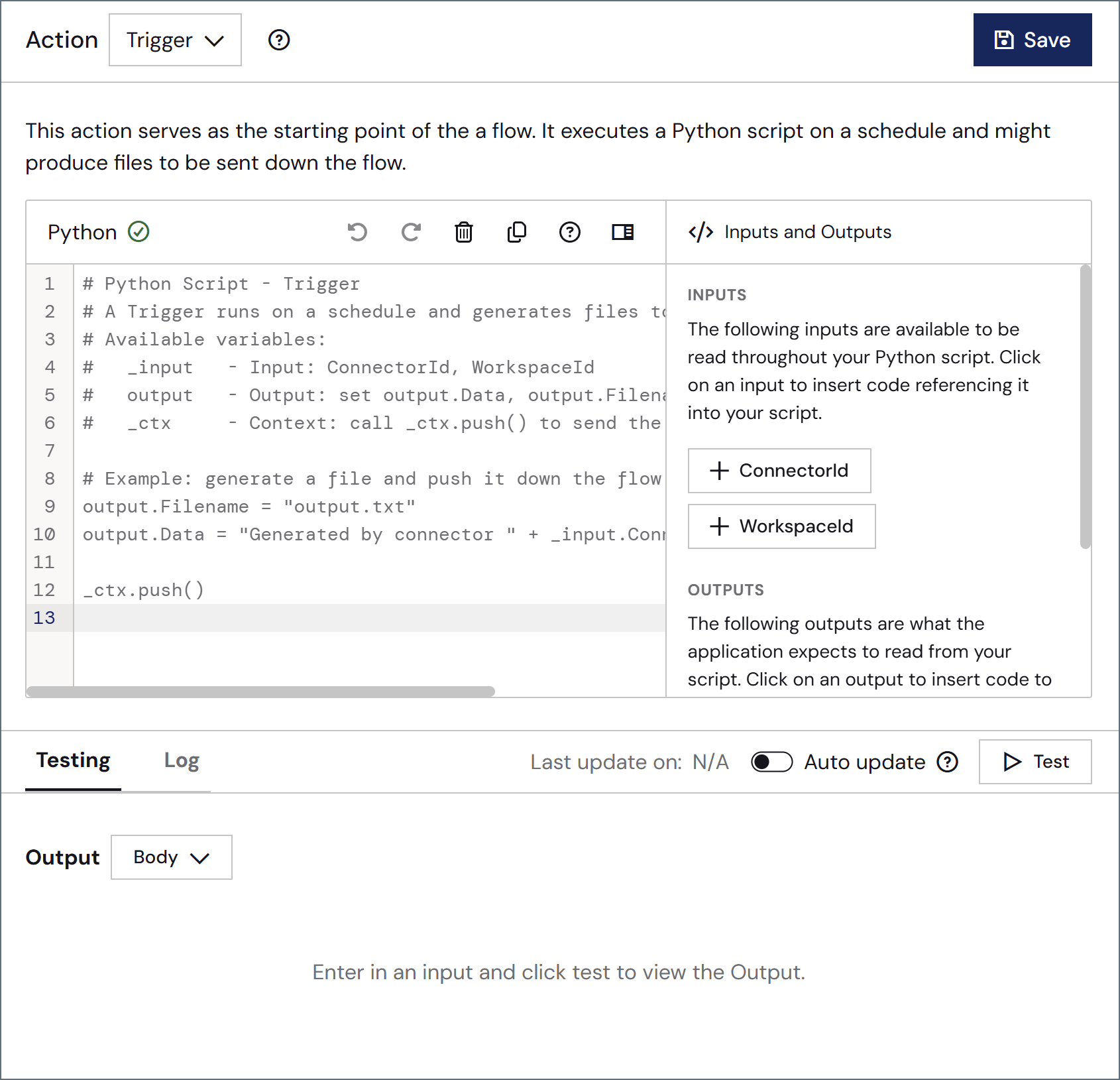
Actions
Settings Tab
Configuration
Settings related to the core operation of the connector.Advanced Settings
Advanced Tab
Logging
Other Settings
Miscellaneous
Automation Tab
Automation Settings
Settings related to the automatic processing of files by the connector.Performance
Alerts Tab
SLAs Tab
Transactions Tab
This tab lists all messages associated with the connector. Use the search bar to find specific messages, or click the funnel icon to apply a filter. You can filter by time, message direction, and/or status. Options on this tab vary depending on the connector’s action type:- If your connector is a Trigger, use the Receive button to start the flow.
- If your connector is a Transform or Terminal, messages that come from a previous connector in the flow automatically appear in the flow, or you can use the Upload Files button to add files.
Producing Output and Log Entries
Python connectors send data to the output feed through the built-inoutput item, which is pushed automatically when the script finishes — no explicit push is needed. (To push a custom item instead, set its attributes and call _ctx.push(item).) Following are three common use cases.
1 Create and output a file:
print() writes to the log file for the current message (as shown above). To write to the application log instead, use _ctx.log('level', 'message') with a level of DEBUG, INFO, WARNING, or ERROR.