

XML Models
The Amazon Marketplace connector models Amazon Marketplace tables in CData Arc as XML. The modelling follows this structure:- A parent element identifies the table to insert into.
- Each child element corresponds to a column in the target table.
</> Code above the configuration pane. The following XML is a simplified example model for a table called Account, which is modeled as the XML element <Account>:
Id, account_c, AccountNumber, and AccountSource are columns in the Account table. When the connector processes an XML file that matches this structure, it automatically inserts the values from that XML into the Account table. When the connector queries the Account table, it outputs XML that matches this structure.
Batching Input
Batching Output
When querying for output, you can configure the connector to support batching records together into a single document. The Max Records setting governs how many records should be included in a single message, and the Batch Size setting indicates how many Batch Messages should be included in a single Batch Group.
Child Tables
Child Table XML
The Input Mapping XML structure is multi-layered when inserting into parent and child tables. The following XML snippet is an example Input Mapping for two tables related by a foreign key:Account is the parent table and AccountPartner is the child table. When the Amazon Marketplace connector processes an input XML file that matches this structure, it updates both tables and ensures that the keys linking the two records are the same.
Using the ref Attribute
Some columns in child tables are marked with a ref tag. This tag indicates that these columns correspond to the primary key in the parent table. After making the insert into the parent table, and before making the insert into the child table, the connector queries the parent table for the primary key of the record it just inserted. The connector then uses this value when inserting into the child table. This is useful when the primary key of the parent table is generated by Amazon Marketplace. In this case, this column is not passed in as input XML, so the connector does not know the value of the column until after it has inserted the record into the parent table. In the XML model, theref attribute indicates that a column can be referenced later or that the value for a column should be read from another column in the mapping. In order to reference the value of columns that are generated by Amazon Marketplace, the column element should include a ref attribute set to the reserved value LAST_INSERT_ID:
ref element to the name of the relevant column:
ref syntax instructs the connector to retrieve the id from the parent table after inserting, and then use that retrieved value as the id column in the child table.
Selecting From Child Tables
Typically, when Selecting from a parent table and a child table, records should only be pulled from the child table if a foreign key matches the primary key from the parent table.
For example, imagine a Select that pulls purchase order data from a PurchaseOrders parent table and a PurchaseOrderLineItems child table. Each record (order) pulled from PurchaseOrders should also pull the line items associated with that order. The two tables are related by a shared PONumber column which is the primary key of the PurchaseOrders table and a foreign key in the PurchaseOrdersLineItems table. Line item records should only be pulled from the child table if the line item's PONumber matches the PONumber of the order being pulled from the parent table.
To establish this relationship in Arc, add a new Filter to the Select and configure it as follows:
- In the left-hand dropdown, select the column of the child table that is the foreign key to the parent table. In the above example, this is the PONumber column of the PurchaseOrderLineItems table.
- In the middle (operator) dropdown, select equal.
- In the right-hand input box, first use the dropdown arrow to the right to select REF. Afterwards, the input box should have the
$prefix, indicating that it is referencing the parent table. - Use the right-hand dropdown to select the parent table column that should match the child table's foreign key. In the above example, this is the PONumber column of the PurchaseOrders table.
Only Process New or Changed Records
Select actions can be configured to only retrieve records that have been updated or added recently. The connector can use two approaches for detecting which records are new or modified.
- The first approach requires a DateTime column that represents the last-modified time for records.
- The second approach requires a column that explicitly stores a value representing whether a record should be processed or not.
Both options are set on the Settings tab in the Advanced settings at the bottom of the configuration panel. To further refine your requirements, see the three additional Process Changes... settings in the Advanced Settings portion of the Advanced tab.
Using a Last Modified Column
If the table includes a DateTime column, a checkbox appears in the Advanced section to Use column for processing new or changed records. Set this to the DateTime column that represents the last-modified time for records.
Using a Custom Column
Pre-Processing and Post-Processing Queries
In Upsert Mappings
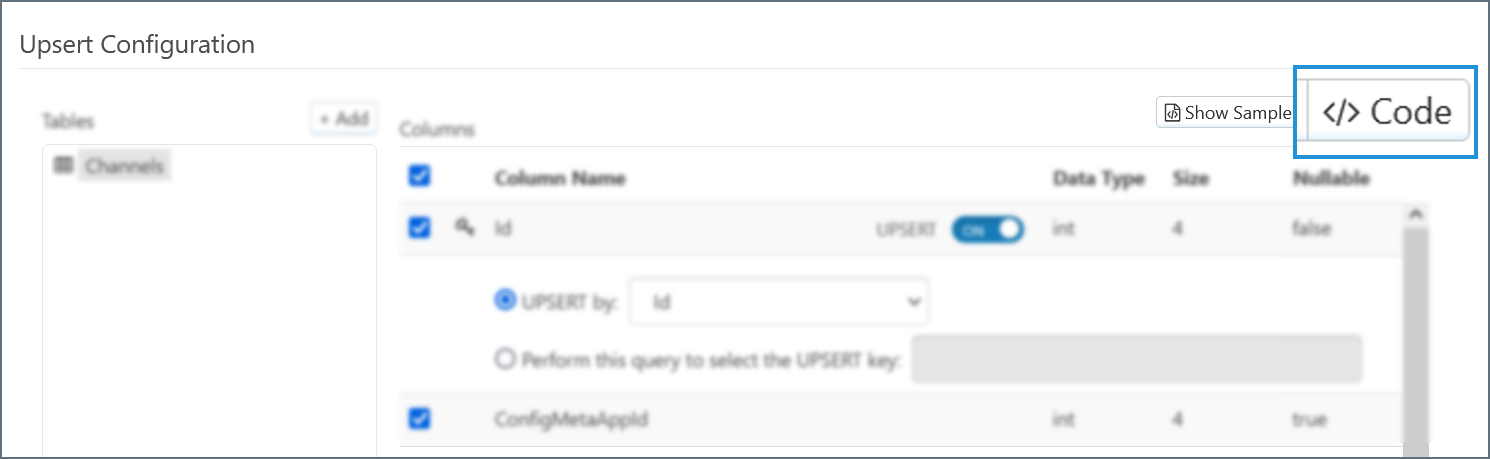
In an Upsert mapping, it is possible to issue queries that automatically take place before or after all records are upserted into a table. To configure this feature, first click</> Code in the Upsert Configuration pane.
requireInput: Set tofalse. This attribute value instructs the connector to issue the query even without any matching input element in the input file.insertQuery: Contains the query that you want to execute either before or after the UPSERT query.table(optional): Set to the name of the table that you want to target with the extra query. (In the examples below, the table name is updateTable.) If you issue the query at the root level of the mapping—that is, as a child of the<Items>element—this attribute is not required. If you issue a query as a child to another table, setting the table attribute ensures that the query is distinguished from a column of that table.
<runFirst> executes the query EXEC [dbo.FlushTemp] before any UPSERT requests to the table:
<runLast> executes the query EXEC [dbo].[CommitTemp] after all UPSERT requests to the table are completed.
runFirst and runLast are placeholders. You can modify them to meet your requirements.
In Select Mappings
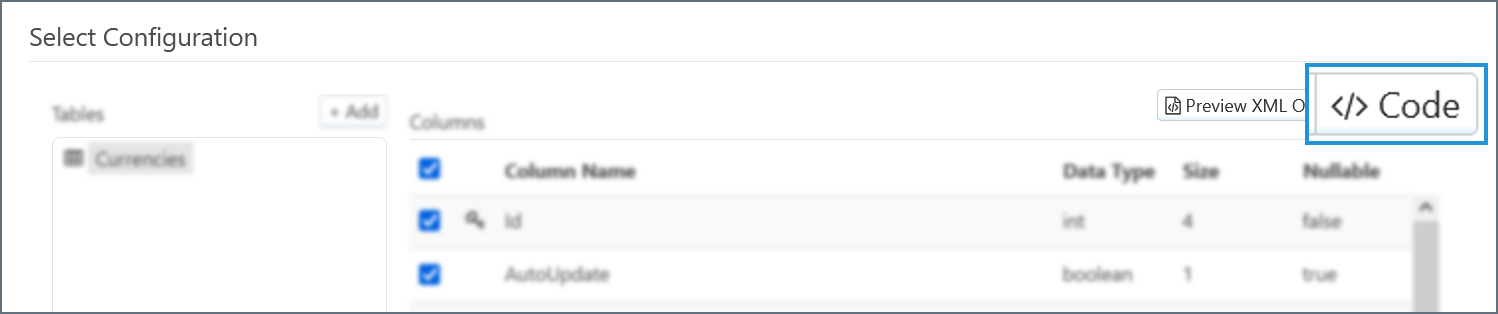
In a Select mapping, it is possible to issue queries that automatically take place before or after queries are issued to the targeted table. To configure this feature, first click</> Code in the Select Configuration pane.
outputResult: Set tofalse. This attribute value instructs the connector not to return any data in the output file as a result of the query.selectQuery: Contains the query that you want to execute either before or after the SELECT query.table(optional): Set to the name of the table that you want to target with the extra query. (In the examples below, the table name is selectTable.) If you issue the query at the root level of the mapping—that is, as a child of the<Items>element—this attribute is not required. If you issue a query as a child to another table, setting the table attribute ensures that the query is distinguished from a column of that table.
<runFirst> executes the query EXEC [dbo].[prepTable] before the SELECT query is issued against the table:
<runLast> executes the query EXEC [dbo].[cleanTable] after the SELECT query and any child queries are issued against the table:
runFirst and runLast are placeholders. You can modify them to meet your requirements.
XML Attributes
Table Attributes
allColumns
In a Select mapping, use this attribute to specify that the output XML should include all columns returned in the query results. This allows you to define an output mapping without needing to explicitly define the names of all columns in the output mapping. Without this attribute, the columns present in the output mapping are used to position returned elements from the query in the order specified in the code view, and elements that are returned in the query but do not contain a matching column are not returned in the output XML.
<MyTable allcolumns="true" selectQuery="SELECT * FROM [MyTable]" />
insertQuery
In an Upsert mapping, you can use this query to override the default query created by the connector when the record is being inserted. It can be used to issue queries beyond the normal Inserts that are associated with an input file.
<runFirst insertQuery="TRUNCATE TABLE [dbo].[Records]" requireInput="false" />
outputResult
In a Select mapping, if you set this attribute, the query matching the Select query is issued without generating content that is to be returned in the output XML. This allows you to run additional queries as part of a transaction that are not reflected in the output of the connector.
<runFirst table="selectTable" selectQuery="EXEC [dbo].[prepTable]" outputResult="false" />
processChangesOnly
In a Select mapping, if you apply the processChangesOnly attribute to the table in combination with applying the timeCheck attribute to a datetime column, the Select mapping uses this column in a dynamically generated WHERE clause in the query to ensure that only new records are retrieved. This corresponds to the column selected in the Use column columnname for processing new or changed records option in the designer. See Only Process New or Changed Records for more information.
<Orders processChangesOnly="true">
requireInput
In an Upsert mapping, if you set this attribute, the query matching the inputQuery is executed independently of whether the input XML contains the matching element. This is used when a pre-processing or post-processing query is issued as part of the same transaction where one or more input elements is present (for example, to truncate a table before entering a new batch, or to run a stored procedure after a batch is complete).
<runFirst insertQuery="TRUNCATE TABLE [dbo].[Records]" requireInput="false" />
selectQuery
In a Select mapping, this is used to define the query and its parameters in the XML. If a a selectQuery is not supplied, a simple SELECT * is issued. You can use selectQuery for custom queries, such as queries using JOIN or other SQL keywords.
<Orders selectQuery="SELECT ID, OrderNo, OrderDate FROM Orders">
table
Used to specify the table that is the target of the mapped query, especially if the table name differs from the valid XML element that maps to it.
<Purchase_Orders table="Purchase Orders">
upsertQuery
In an Upsert mapping, use this query to determine whether the record being processed is a new record (INSERT) or an existing record being updated (UPDATE). The action is determined based on whether a matching result to this query is found.
<Records action="upsert" upsertQuery="SELECT ID FROM Records WHERE Key1 = @Key1 and Key2 = @Key2">
Column Attributes
aggregate
In some cases, the value of a column in a mapping might itself be an XML aggregate. The default behavior is to treat the column as a string and use XML encoding to encode the value of the aggregate in the column. However, when the aggregate attribute is present on a column, the XML file that maps to the table has the value of any aggregate column as raw XML instead of encoded to a single element.
<LineItems aggregate="true" />
column
The column attribute on a column in a mapping provides the name of the column in the table being referenced. This allows you to accomplish several things:
- Map to columns that are not valid XML elements
- Create an alias to a column in the database to distinguish it from a similarly named column in another table
- Use an easier-to-read element in the XML model
<New_data column="New Data" />
id
In a Select mapping, this tags the value of a column with an Id marker that can be referenced later in a child query using the syntax${#ID}. This is useful when a column value is needed in a child query where matching column names in multiple tables can create ambiguity in the selection.
key
Identifies the column as a primary key on the table. When this attribute is present on an Upsert query, the connector checks if the record exists before updating it. If it is not present on a table, only Inserts are allowed to the table, and you cannot update column values after selecting records, because there is no way to identify unique records. (You can overwrite an existing column to act as a key if you are positive that it can be used in the same way as a key column.)
<ID key="true" type="integer"/>
ref
In an Upsert mapping, this attribute is used to provide values to upsert into the database that cannot be determined from the input XML alone. This is most commonly used in parent-child relationships to determine the database-generated primary key, or for one table to use a foreign key reference on a child table. For more information, see Using the ref Attribute.timeCheck
In a Select mapping, if you apply the processChangesOnly attribute to the table in combination with applying the timeCheck attribute to a datetime column, the Select mapping uses this column in a dynamically generated WHERE clause in the query to ensure that only new records are retrieved. This corresponds to the column selected in the Use column columnname for processing new or changed records option in the designer. See Only Process New or Changed Records for more information.
<LastModified timeCheck="true" />
type
Used to identify the data type of the column in the table. For Upsert queries, the type is validated against the value in the column before the query is executed.
<ID key="true" type="integer"/>
updateValue
In a Select mapping, any record selected from the database is updated after retrieval with a new value in this column. This corresponds to the Update column columnname with value value when rows are processed successfully option in the designer.
<Exported updateValue="true" />