

Key Capabilities
- Custom business logic implementation using Script or Python
- Access to full message context including message headers and file content
- Integration with external libraries and system commands (Python)
- Support for complex data transformations and business rule processing
Overview
Script connectors use the powerful Script scripting language to accomplish a wide range of custom behavior. The script configured in the connector is run each time a document is placed in the Transactions tab for the connector. The input document can be read and modified in the script, or the input document can simply trigger an external function configured in the connector. Script connectors can also be configured to run on a schedule via Receive automation on the Automation tab. These are a few of the tasks you can configure a Script connector to do:- Replace values in the input document with data returned from custom SQL queries
- Call a custom Web service to invoke a specialized workflow
- Run an external script or executable via the sysExecute operation
Connector Configuration
This section contains all of the configurable connector properties.Script Tab
Options related to writing and testing the script.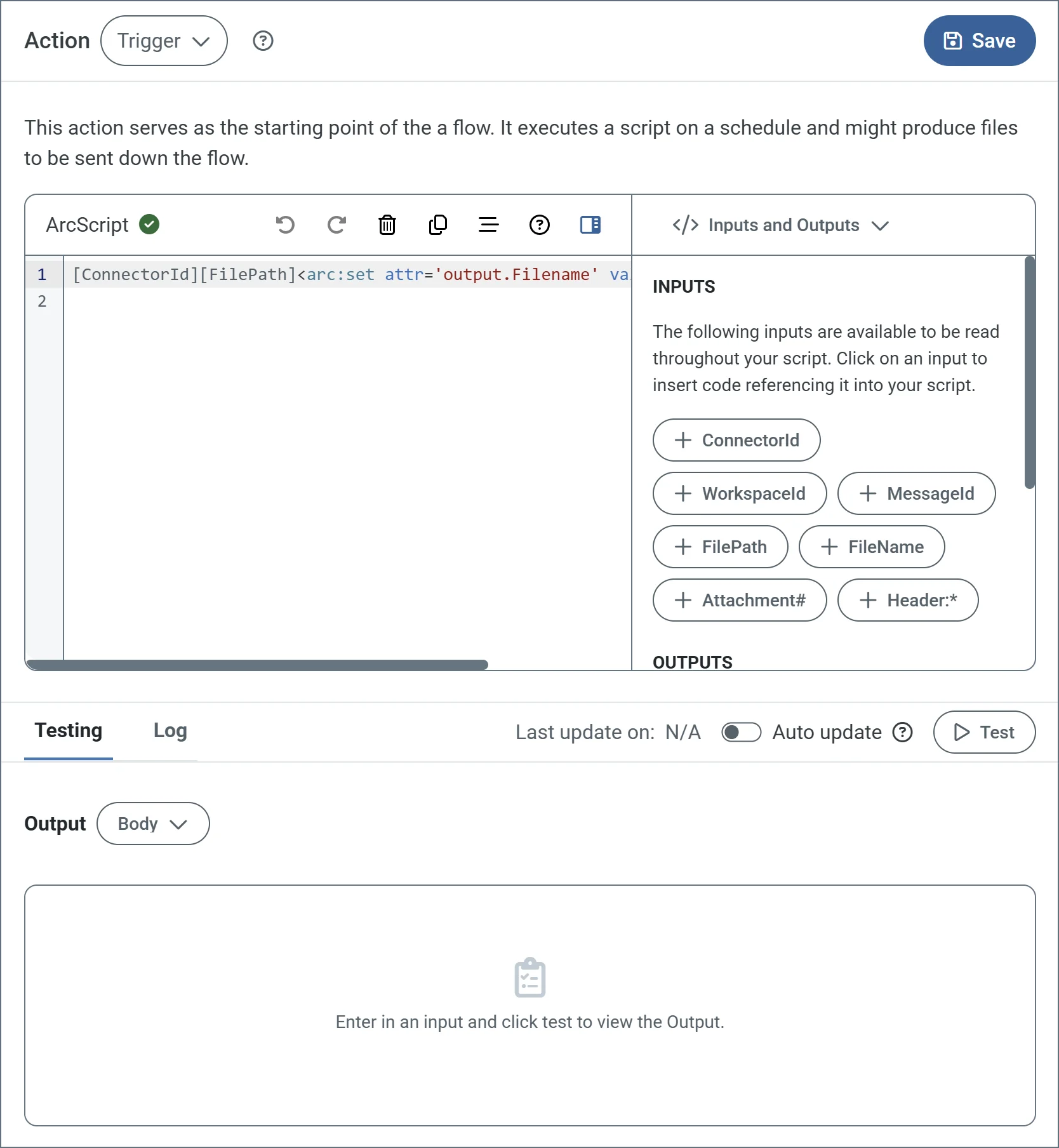
Actions
Settings Tab
Configuration
Settings related to the core operation of the connector.Advanced Settings
Advanced Tab
Logging
Other Settings
Miscellaneous
Automation Tab
Automation Settings
Settings related to the automatic processing of files by the connector.Performance
Alerts Tab
SLAs Tab
Transactions Tab
This tab lists all messages associated with the connector. Use the search bar to find specific messages, or click the funnel icon to apply a filter. You can filter by time, message direction, and/or status. Options on this tab vary depending on the connector’s action type:- If your connector is a Trigger, use the Receive button to start the flow.
- If your connector is a Transform or Terminal, use the Upload Files button to upload files to the flow.
Using the arc:push Keyword
The arc:push keyword is commonly used in Script connectors to pass items to the output feed of the script. In addition, when you select an Output attribute from the Insert Options menu, if anarc:push keyword is not already included in the script, auto-injects it so the script can work. Following are three common use cases.
1 Create and output a file: