> ## Documentation Index
> Fetch the complete documentation index at: https://docs.arc.cdata.com/llms.txt
> Use this file to discover all available pages before exploring further.

# ICAP Connector

> The ICAP connector enables integration with Internet Content Adaptation Protocol servers for real-time security scanning and content adaptation services.

export const CommonProxySettings = () => <>
    <p>これらは、接続のルーティング先となるプロキシを識別し認証するための一連の設定です。デフォルトでは、このセクションは<a href="/26.3/cloud/ja/getting-started/administration/settings/security">Security Settings</a> ページの<a href="/26.3/cloud/ja/getting-started/administration/settings/proxy-settings">Proxy Settings</a> 部分にあるグローバル設定を使用します。チェックボックスをオフにすると、コネクタ固有の設定を指定できます。</p>
    <table>
      <thead>
        <tr><th>設定</th><th>説明</th></tr>
      </thead>
      <tbody>
        <tr>
          <td><strong>Proxy Type</strong></td>
          <td>プロキシベースのファイアウォールで使用されるプロトコル。</td>
        </tr>
        <tr>
          <td><strong>Proxy Host</strong></td>
          <td>プロキシベースのファイアウォールの名前またはIP アドレス。</td>
        </tr>
        <tr>
          <td><strong>Proxy Port</strong></td>
          <td>プロキシベースのファイアウォールのTCP ポート。</td>
        </tr>
        <tr>
          <td><strong>Proxy User</strong></td>
          <td>プロキシベースのファイアウォールで認証するために使用するユーザー名。</td>
        </tr>
        <tr>
          <td><strong>Proxy Password</strong></td>
          <td>プロキシベースのファイアウォールで認証するために使用するパスワード。</td>
        </tr>
        <tr>
          <td><strong>Authentication Scheme</strong></td>
          <td>デフォルトの<strong>None</strong> のままにするか、次の認証スキームのいずれかを選択します：<strong>Basic</strong>、<strong>Digest</strong>、<strong>Proprietary</strong>、または<strong>NTLM</strong>。</td>
        </tr>
      </tbody>
    </table>
  </>;

export const SlasTab = ({siteName = "CData Arc"}) => <>
    <p><em>サービスレベルアグリーメント（SLA）の設定に関する設定です。</em></p>
    <p>
      SLA を使用すると、フロー内のコネクタが送受信すると見込まれるボリュームを設定し、そのボリュームを達成すると見込まれる期間を設定できます。{siteName} は、SLA が達成されない場合にユーザーへ警告するメールを送信し、SLA を<em>At Risk</em> としてマークします。これは、SLA が間もなく達成されない場合に<em>Violated</em> としてマークされることを意味します。これにより、ユーザーは介入してSLA が達成されない理由を特定し、適切な対応を取る機会を得られます。At Risk 期間の終了時点でもSLA が達成されない場合、SLA はviolated としてマークされ、ユーザーに再度通知されます。
    </p>
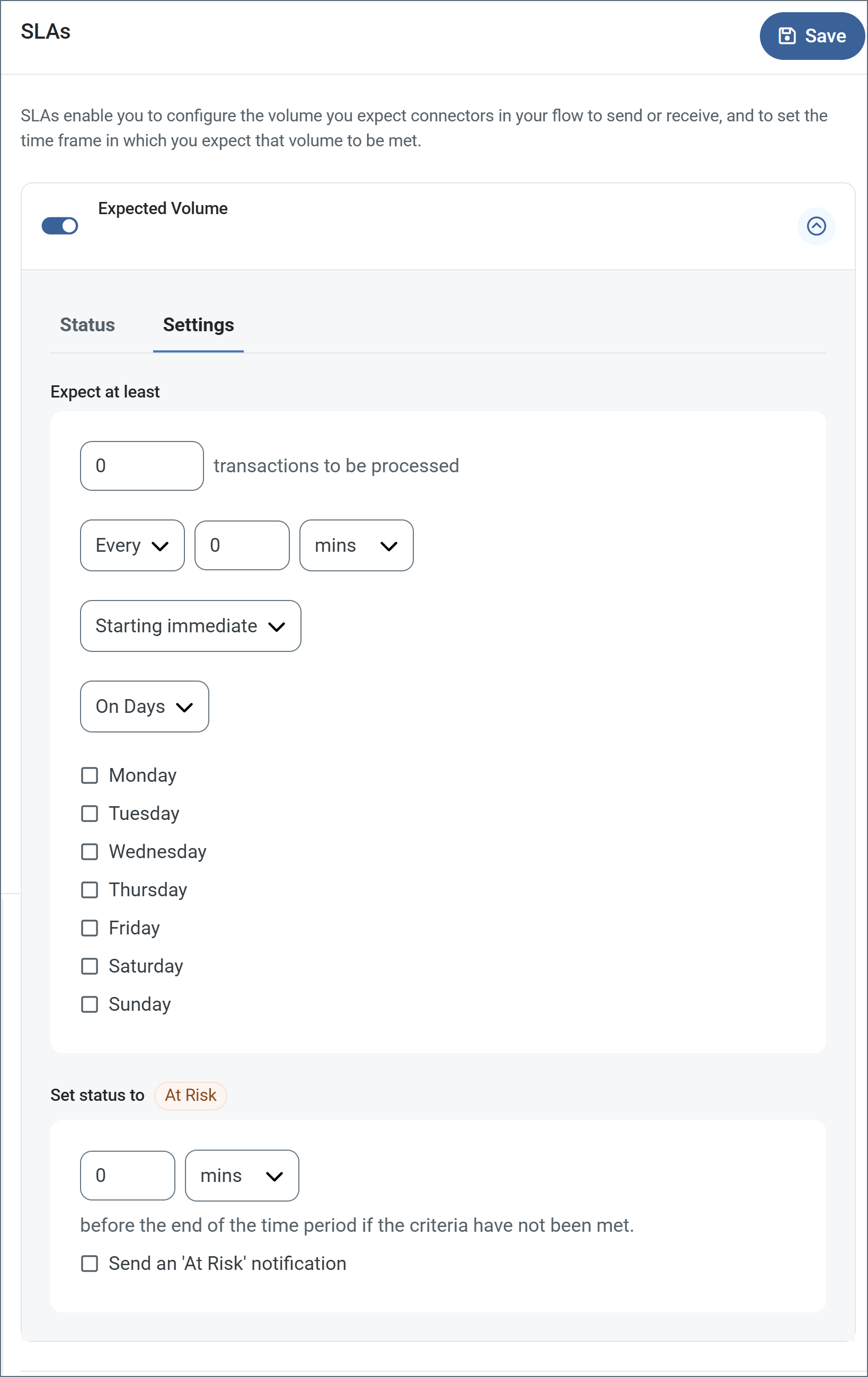
    <p>
      SLA を定義するには、<strong>Expected Volume</strong> をオンに切り替え、<strong>Settings</strong> タブをクリックします。
    </p>
    <img src="/public/images/sla_empty.png" alt="SLA Empty" />
    <ul>
      <li>コネクタに送信と受信の個別のアクションがある場合は、ラジオボタンを使用してSLA がどちらの方向に適用されるかを指定します。</li>
      <li>ウィンドウの<strong>Expect at least</strong> 部分で、次を設定します。
        <ul>
          <li>処理を見込む最小トランザクション数（ボリューム）を設定します。</li>
          <li><strong>Every</strong> フィールドを使用して期間を指定します。</li>
          <li>SLA を有効にするタイミングを指定します。<strong>Starting on</strong> を選択した場合は、日付および時刻フィールドを入力します。</li>
          <li>SLA を有効にしたい曜日のチェックボックスをオンにします。必要に応じて、ドロップダウンで<strong>Everyday</strong> を選択します。</li>
        </ul>
      </li>
      <li>ウィンドウの<strong>Set status to 'At Risk'</strong> 部分で、SLA をAt Risk としてマークするタイミングを指定します。
        <ul>
          <li>デフォルトでは、SLA が違反状態になるまで通知は送信されません。これを変更するには、<strong>Send an 'At Risk' notification</strong> をオンにします。</li>
        </ul>
      </li>
    </ul>
    <p>
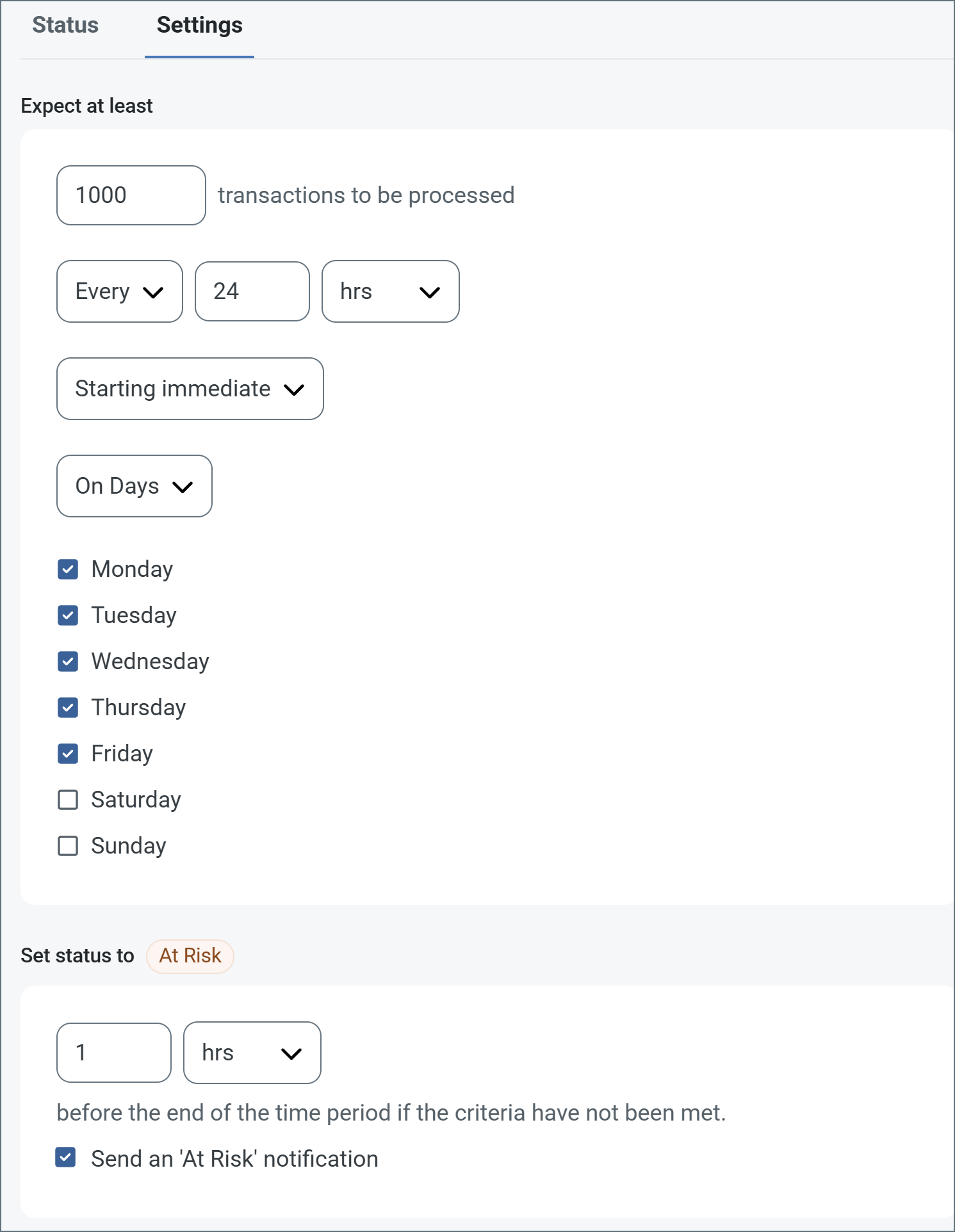
      次の例は、月曜日から金曜日まで毎日1000 件のファイルを受信すると見込むコネクタ向けに設定されたSLA を示しています。1000 件のファイルが受信されていない場合、期間の終了の1時間前にAt Risk 通知が送信されます。
    </p>
    <img src="/public/images/sla_defined.png" alt="SLA Configuration Example" />
    <Note>
      必要に応じてSLA アラートをオフにすることができます。これはメンテナンスウィンドウ中に役立ちます。navbar で<strong>Settings</strong> をクリックし、<strong>Alerts &gt; General Alerts</strong> に移動します。タブレットと鉛筆のアイコンをクリックして編集し、<strong>SLA Alerts</strong> 設定のチェックを外します。
    </Note>
  </>;

export const AlertsTab = ({siteNameShort = "Arc"}) => <>
    <p><em>アラートの設定に関する設定です。</em></p>
    <p>
      サービスレベルアグリーメント（SLA）を実行する前に、通知用のメールアラートをセットアップする必要があります。デフォルトでは、{siteNameShort} は<a href="/26.3/cloud/ja/getting-started/administration/settings/alerts">Alerts</a> タブのグローバル設定を使用します。このコネクタに別の設定を使用するには、<strong>Override global setting</strong> をオンに切り替えます。
    </p>
    <p>
      デフォルトではエラーアラートが有効になっており、エラーが発生するたびにメールが送信されます。これをオフにするには、<strong>Enable</strong> チェックボックスのチェックを外します。
    </p>
    <p>
      <strong>Subject</strong>（必須）を入力します。<strong>Allow {siteNameShort}Script in Subject</strong> をチェックすると、<strong>Subject</strong> フィールドで{siteNameShort}Script を使用できます。これを選択すると、<strong>{siteNameShort}Script エディタ</strong>ボタンが表示されます（<img src="/public/images/rest_arcscript_editor.png" alt="arcscript editor button" style={{
  display: 'inline',
  verticalAlign: 'middle',
  margin: 0
}} />）。
    </p>
    <p>
      必要に応じて<strong>Recipient</strong> のメールアドレスをカンマ区切りのリストで入力します。
    </p>
  </>;

export const MiscConnector = () => <>
    <p><em>Miscellaneous 設定は、特定のユースケース向けの設定です。</em></p>
    <table>
      <thead>
        <tr>
          <th>設定</th>
          <th>説明</th>
        </tr>
      </thead>
      <tbody>
        <tr>
          <td><strong>Other Settings</strong></td>
          <td>非表示のコネクタ設定をセミコロン区切りのリストで設定できます（例：<code>setting1=value1;setting2=value2</code>）。通常のコネクタのユースケースや機能では、これらの設定の使用は必要ありません。</td>
        </tr>
      </tbody>
    </table>
  </>;

export const Logging = () => <>
    <p><em>ログの作成と保存を制御する設定です。</em></p>
    <table>
      <thead>
        <tr>
          <th>設定</th>
          <th>説明</th>
        </tr>
      </thead>
      <tbody>
        <tr>
          <td><strong>Log Level</strong></td>
          <td>コネクタが生成するログの詳細度です。サポートを依頼する際は、これを<strong>Debug</strong> に設定してください。</td>
        </tr>
        <tr>
          <td><strong>Log Subfolder Scheme</strong></td>
          <td>選択した間隔に従って、コネクタがLogs フォルダ内のファイルをグループ化するよう指示します。<strong>Weekly</strong> オプション（デフォルト）は、コネクタが毎週新しいサブフォルダを作成し、その週のすべてのログをそのフォルダに保存するよう指示します。この設定を空白のままにすると、コネクタはすべてのログをLogs フォルダに直接保存します。多数のトランザクションを処理するコネクタでは、サブフォルダを使用することでログを整理しやすくなり、パフォーマンスが向上します。</td>
        </tr>
        <tr>
          <td><strong>Log Messages</strong></td>
          <td>処理したファイルのログエントリにファイル自体のコピーを含めるには、これをオンにします。これを無効にすると、<strong>Transactions</strong> タブからファイルのコピーをダウンロードできなくなる場合があります。</td>
        </tr>
      </tbody>
    </table>
  </>;

export const MacrosExamples = ({extraMacros = []}) => <>
    <p>
      %Ext% や %ShortDate% などの一部のマクロは引数を必要としませんが、引数を必要とするものもあります。
      引数を取るすべてのマクロは次の構文を使用します。<code>%Macro:argument%</code>
    </p>

    <p>引数を取るマクロの例を次に示します。</p>

    <ul>
      <li>%Header:headername%：<code>headername</code> はメッセージ上のヘッダーの名前です。</li>
      <li>%Header:mycustomheader% は、入力メッセージに設定された<code>mycustomheader</code> ヘッダーの値に解決されます。</li>
      <li>%Header:ponum% は、入力メッセージに設定された<code>ponum</code> ヘッダーの値に解決されます。</li>
      <li>%RegexFilename:pattern%：<code>pattern</code> は正規表現パターンです。例えば、<code>%RegexFilename:^([\w][A-Za-z]+)%</code> は、ファイル名の最初の単語にマッチしてそれに解決され、大文字・小文字を区別しません（<code>test_file.xml</code> は<code>test</code> に解決されます）。</li>
      <li>%Vault:vaultitem%：<code>vaultitem</code> は<a href="/26.3/cloud/ja/getting-started/administration/settings/global-settings-vault">Vault</a> 内のアイテムの名前です。例えば、<code>%Vault:companyname%</code> は、Vault に保存された<code>companyname</code> アイテムの値に解決されます。</li>
      <li>%DateFormat:format%：<code>format</code> は許容される日付形式です（詳細は<a href="/26.3/cloud/ja/scripting/value-formatters/date-formatters#sample-date-formats">日付形式のサンプル</a>を参照してください）。例えば、<code>%DateFormat:yyyy-MM-dd-HH-mm-ss-fff%</code> は、ファイルの日付とタイムスタンプに解決されます。</li>
      {extraMacros.filter(item => item.example).map(item => <li key={`ex-${item.name}`}>{item.example}</li>)}
    </ul>

    <p>次の例に示すように、より高度なマクロを作成することもできます。</p>

    <ul>
      <li>1 つのファイル名で複数のマクロを組み合わせる：<code>%DateFormat:yyyy-MM-dd-HH-mm-ss-fff%%EXT%</code></li>
      <li>マクロの外側にテキストを含める：<code>MyFile_%DateFormat:yyyy-MM-dd-HH-mm-ss-fff%</code></li>
      <li>マクロの内側にテキストを含める：<code>%DateFormat:'DateProcessed-'yyyy-MM-dd_'TimeProcessed-'HH-mm-ss%</code></li>
    </ul>
  </>;

export const MacrosTable = ({siteName = "CData Arc", extraMacros = []}) => <>
    <p>
      ファイル命名戦略でマクロを使用すると、データの整理効率と文脈の理解を高めることができます。
      ファイル名にマクロを組み込むことで、識別子、タイムスタンプ、ヘッダー情報などの関連情報を
      動的に含めることができ、各ファイルに有用な文脈を提供します。
    </p>

    <p>{siteName} は次のマクロをサポートしています。これらはすべて次の構文を使用します。<code>%Macro%</code></p>

    <table>
      <thead>
        <tr><th>マクロ</th><th>説明</th></tr>
      </thead>
      <tbody>
        <tr><td>ConnectorID</td><td>コネクタのConnectorID に評価されます。</td></tr>
        <tr><td>ConnectorName</td><td>コネクタの名前に評価されます。ファイル名やパスに接続名を含めることができます。例えば、どのデータベース接続が生成したかによってバックアップファイルにタグを付けるために使用できます。</td></tr>
        <tr><td>Ext</td><td>コネクタが現在処理しているファイルの拡張子に評価されます。</td></tr>
        <tr><td>Filename</td><td>コネクタが現在処理しているファイルのファイル名（拡張子を含む）に評価されます。</td></tr>
        <tr><td>FilenameNoExt</td><td>コネクタが現在処理しているファイルのファイル名（拡張子を除く）に評価されます。</td></tr>
        <tr><td>MessageId</td><td>コネクタが出力しているメッセージのMessageId に評価されます。</td></tr>
        <tr><td>RegexFilename:<em>pattern</em></td><td>コネクタが現在処理しているファイルのファイル名に正規表現パターンを適用します。</td></tr>
        <tr><td>Header:<em>headername</em></td><td>コネクタが現在処理しているメッセージ上の対象ヘッダー（<code>headername</code>）の値に評価されます。</td></tr>
        <tr><td>LongDate</td><td>システムの現在の日時を長い形式（例：Wednesday, January 24, 2024）で評価します。</td></tr>
        <tr><td>ShortDate</td><td>システムの現在の日時をyyyy-MM-dd 形式（例：2024-01-24）で評価します。</td></tr>
        <tr><td>DateFormat:<em>format</em></td><td>システムの現在の日時を指定された形式（<code>format</code>）で評価します。利用可能な日時形式については、<a href="/26.3/cloud/ja/scripting/value-formatters/date-formatters#date-formats-with-literal-characters">日付形式のサンプル</a>を参照してください。</td></tr>
        <tr><td>Vault:<em>vaultitem</em></td><td>指定されたVault アイテムの値に評価されます。</td></tr>
        {extraMacros.map(item => <tr key={item.name}>
            <td>{item.name}</td>
            <td>{item.description}</td>
          </tr>)}
      </tbody>
    </table>
  </>;

export const Performance = () => <>
    <p><em>コネクタへのリソースの割り当てに関する設定です。</em></p>
    <table>
      <thead>
        <tr>
          <th>設定</th>
          <th>説明</th>
        </tr>
      </thead>
      <tbody>
        <tr>
          <td><strong>Max Workers</strong></td>
          <td>このコネクタでファイルを処理するためにスレッドプールから消費されるワーカースレッドの最大数です。設定すると、<a href="/26.3/cloud/ja/getting-started/administration/settings/advanced-settings">Advanced Settings</a> ページの<a href="/26.3/cloud/ja/getting-started/administration/settings/performance-settings">Performance Settings</a> 部分にあるデフォルト設定が上書きされます。</td>
        </tr>
        <tr>
          <td><strong>Max Files</strong></td>
          <td>コネクタに割り当てられた各スレッドが送信するファイルの最大数です。設定すると、<a href="/26.3/cloud/ja/getting-started/administration/settings/advanced-settings">Advanced Settings</a> ページの<a href="/26.3/cloud/ja/getting-started/administration/settings/performance-settings">Performance Settings</a> 部分にあるデフォルト設定が上書きされます。</td>
        </tr>
      </tbody>
    </table>
  </>;

export const siteNameShort = "Arc";

export const siteName = "CData Arc";

The ICAP connector enables seamless integration with Internet Content Adaptation Protocol (ICAP) servers in CData Arc. This connector facilitates content adaptation services, particularly real-time security scanning, by acting as an intermediary between your application and ICAP-compliant servers.

## Key Capabilities

* Real-time content adaptation and security scanning
* Support for both request modification (REQMOD) and response modification (RESPMOD) modes
* TLS encryption support for secure communications
* Customizable HTTP encapsulation for legacy system compatibility
* Flexible authentication options including private certificate support
* Functions as a Transform step in the flow. Files that are flagged as needing attention yield errors, while other files proceed down the flow as usual.

## Connector Configuration

This section contains all of the configurable connector properties.

### Settings Tab

*Settings related to the core configuration of the connector.*

| Setting                                     | Description                                                                                                                                                                                                                                                                                                                                                                                                                                                                                                                                                                                                                                                                                                                                                                                                                                                                                                                                                                                                                                                                                                                                                                                                                                                                                                                                                                                                                                                                                                                                                                                                                                                                                                                                                                                          |
| ------------------------------------------- | ---------------------------------------------------------------------------------------------------------------------------------------------------------------------------------------------------------------------------------------------------------------------------------------------------------------------------------------------------------------------------------------------------------------------------------------------------------------------------------------------------------------------------------------------------------------------------------------------------------------------------------------------------------------------------------------------------------------------------------------------------------------------------------------------------------------------------------------------------------------------------------------------------------------------------------------------------------------------------------------------------------------------------------------------------------------------------------------------------------------------------------------------------------------------------------------------------------------------------------------------------------------------------------------------------------------------------------------------------------------------------------------------------------------------------------------------------------------------------------------------------------------------------------------------------------------------------------------------------------------------------------------------------------------------------------------------------------------------------------------------------------------------------------------------------- |
| **Connector Id**                            | The static, unique identifier for the connector.                                                                                                                                                                                                                                                                                                                                                                                                                                                                                                                                                                                                                                                                                                                                                                                                                                                                                                                                                                                                                                                                                                                                                                                                                                                                                                                                                                                                                                                                                                                                                                                                                                                                                                                                                     |
| **Connector Type**                          | Displays the connector name and a description of what it does.                                                                                                                                                                                                                                                                                                                                                                                                                                                                                                                                                                                                                                                                                                                                                                                                                                                                                                                                                                                                                                                                                                                                                                                                                                                                                                                                                                                                                                                                                                                                                                                                                                                                                                                                       |
| **Connector Description**                   | An optional field to provide a free-form description of the connector and its role in the flow.                                                                                                                                                                                                                                                                                                                                                                                                                                                                                                                                                                                                                                                                                                                                                                                                                                                                                                                                                                                                                                                                                                                                                                                                                                                                                                                                                                                                                                                                                                                                                                                                                                                                                                      |
| **ICAP URI**                                | (Required) The ICAP Uniform Resource Identifier (URI) of the ICAP server to connect to. Must be in this format: `icap://<hostname>:<port>/<service_name>`.                                                                                                                                                                                                                                                                                                                                                                                                                                                                                                                                                                                                                                                                                                                                                                                                                                                                                                                                                                                                                                                                                                                                                                                                                                                                                                                                                                                                                                                                                                                                                                                                                                           |
| **Allow {siteNameShort}Script in ICAP URI** | Allows for the evaluation of {siteNameShort}Script expressions in the URI. When you select this, the **{siteNameShort}Script Editor** button appears (<img src="https://mintcdn.com/cdata-arc/AKthyJ-LnqphL8js/public/images/rest_arcscript_editor.png?fit=max&auto=format&n=AKthyJ-LnqphL8js&q=85&s=787722dc2403ad060cf1a162132beba3" alt="arcscript editor button" style={{display: 'inline', verticalAlign: 'middle', margin: 0}} width="26" height="22" data-path="public/images/rest_arcscript_editor.png" />), which enables you to build dynamic request URIs using {siteNameShort}Script. |
| **ICAP Headers**                            | Optional headers for specialized server requirements. Use this to add custom ICAP request headers that you want to include in the outgoing ICAP request.                                                                                                                                                                                                                                                                                                                                                                                                                                                                                                                                                                                                                                                                                                                                                                                                                                                                                                                                                                                                                                                                                                                                                                                                                                                                                                                                                                                                                                                                                                                                                                                                                                             |
| **Allow {siteNameShort}Script in Headers**  | Allows for the evaluation of {siteNameShort}Script expressions in the headers before the query is issued. For example, `[_ \| now('yyyy-MM-dd')]` evaluates the current date, and `[_message.header:headername]` evaluates the headername header from the input message context.                                                                                                                                                                                                                                                                                                                                                                                                                                                                                                                                                                                                                                                                                                                                                                                                                                                                                                                                                                                                                                                                                                                                                                                                                                                                                                                                                                                                                                                                                                                     |
| **TLS Configuration**                       | Check this to enable TLS encryption for the ICAP connection.                                                                                                                                                                                                                                                                                                                                                                                                                                                                                                                                                                                                                                                                                                                                                                                                                                                                                                                                                                                                                                                                                                                                                                                                                                                                                                                                                                                                                                                                                                                                                                                                                                                                                                                                         |
| **TLS Server Certificate**                  | The public key certificate used to verify the identity of an TLS/SSL server. This is only necessary if the ICAP server has enabled TLS. Set it to `Any Certificate` to unconditionally trust the ICAP server's identity. Only relevant when **TLS Configuration** is enabled.                                                                                                                                                                                                                                                                                                                                                                                                                                                                                                                                                                                                                                                                                                                                                                                                                                                                                                                                                                                                                                                                                                                                                                                                                                                                                                                                                                                                                                                                                                                        |
| **Local File Scheme**                       | A scheme for assigning filenames to messages that are output by the connector. You can use macros in your filenames dynamically to include information such as identifiers and timestamps. For more information, see [Macros](#macros).                                                                                                                                                                                                                                                                                                                                                                                                                                                                                                                                                                                                                                                                                                                                                                                                                                                                                                                                                                                                                                                                                                                                                                                                                                                                                                                                                                                                                                                                                                                                                              |

### Advanced Tab

#### TLS Client Authentication

| Setting                  | Description                                                              |
| ------------------------ | ------------------------------------------------------------------------ |
| **Private Certificate**  | Select, create, or upload the TLS certificate to use for authentication. |
| **Certificate Password** | The password required to access the **Private Certificate**.             |

#### Other Settings

| Setting                   | Description                                                                                                                                                                                                                                                                                                                                                                  |
| ------------------------- | ---------------------------------------------------------------------------------------------------------------------------------------------------------------------------------------------------------------------------------------------------------------------------------------------------------------------------------------------------------------------------- |
| **ICAP Mode**             | Specify the type of ICAP transaction: use REQMOD for request modification or RESPMOD for response modification. The default is REQMOD.                                                                                                                                                                                                                                       |
| **Preview size**          | Controls the size of the message body preview sent to the ICAP server. `Automatic` makes your client query the server using an OPTIONS request to determine the optimal preview size. Alternatively, you can specify an exact number (in bytes) to use for the preview size.                                                                                                 |
| **Chunk size**            | The maximum size (in bytes) of each data chunk sent after the preview phase (or for requests without a preview). The default is 16KB.                                                                                                                                                                                                                                        |
| **Timeout (seconds)**     | The length of time in seconds that the connector waits for a connection response before throwing a timeout error. The default is 60 seconds.                                                                                                                                                                                                                                 |
| **Response Headers**      | A comma-separated list of ICAP response header names (such as `X-Infection-Found,X-Scan-Result`) to be extracted and added as metadata to the processed message.                                                                                                                                                                                                             |
| **TLS Enabled Protocols** | The list of TLS/SSL protocols supported when establishing outgoing connections. Best practice is to only use TLS protocols. SSL v2 and SSL v3 are considered vulnerable and should only be used if your partner does not support higher versions. Keep in mind that TLS v1.3 is not universally adopted, and might be refused if the destination server does not support it. |

#### Proxy Settings

<CommonProxySettings />

#### Logging

<Logging />

#### Miscellaneous

<MiscConnector />

### Automation Tab

#### Automation Settings

*Settings related to the automatic processing of files by the connector.*

| Setting  | Description                                                                          |
| -------- | ------------------------------------------------------------------------------------ |
| **Send** | Whether files arriving at the connector are automatically sent as ICAP transactions. |

#### Performance

<Performance />

### Alerts Tab

<AlertsTab />

### SLAs Tab

<SlasTab />

### Transactions Tab

This tab lists all messages associated with the connector. Use the search bar to find specific messages, or click the funnel icon to apply a filter. You can filter by time, message direction, and/or status.

Incoming responses appear on this tab.

### Events Tab

| Event             | Description                                                                                                                                                                                                                                                                                                                                                                                                                                                                                                                        |
| ----------------- | ---------------------------------------------------------------------------------------------------------------------------------------------------------------------------------------------------------------------------------------------------------------------------------------------------------------------------------------------------------------------------------------------------------------------------------------------------------------------------------------------------------------------------------- |
| **Response**      | This event lets you extend the way the connector interprets replies from the ICAP server. By default, the connector finalizes messages based on the ICAP server's status code. However, since ICAP servers can also include scan details in response headers, the Response event lets you apply custom logic to those headers for more granular control. No output is created from this event; instead, you can use the `arc:throw` keyword to block the file (for example, if a particular header value indicates a failed scan). |
| **Before Send**   | This event fires after the connector has fully prepared a file to send/process a file, but before the sending/processing actually occurs.                                                                                                                                                                                                                                                                                                                                                                                          |
| **After Receive** | This event fires after the connector has received a file.                                                                                                                                                                                                                                                                                                                                                                                                                                                                          |

The following are available in the Response event:

* StatusCode: The ICAP response status code (such as 200, 204, or 4xx)
* \_response: The ICAP response. You can use `[_response.header:xxx]` to get a specific header.
* \_message: To refer to the input message (headers and body), and adding headers to the output.

## Macros

<MacrosTable />

### Examples

<MacrosExamples />