> ## Documentation Index
> Fetch the complete documentation index at: https://docs.arc.cdata.com/llms.txt
> Use this file to discover all available pages before exploring further.
# Box Connector
> Configuration and usage guide for the CData Arc Box connector, which supports uploading to and downloading from the Box cloud storage service.
export const CommonCacheCleanup = () => <>
Arc automatically cleans up the resource cache. This process runs in the background during every receive cycle and removes stale cache entries for files that are no longer present on the remote server. This keeps the cache size manageable without requiring any manual action.
By default, files are retained for 30 days, but you can use the ResourceCacheRetentionDays setting in the Other Settings field on the Advanced tab to adjust it to fit your environment. For example, ResourceCacheRetentionDays=15 retains files for 15 days before removing them.
;
export const NameDescription = ({extraRows}) =>
| Setting |
Description |
| Connector Id |
The static, unique identifier for the connector. |
| Connector Type |
Displays the connector name and a description of what it does. |
| Connector Description |
An optional field to provide a free-form description of the connector and its role in the flow. |
{extraRows}
;
export const CommonProxySettings = () => <>
These are a collection of settings that identify and authenticate to the proxy through which the connection should be routed. By default, this section uses the global settings on the Proxy Settings portion of the Security Settings page. Clear the checkbox to supply settings specific to your connector.
| Setting | Description |
|---|
| Proxy Type |
The protocol used by a proxy-based firewall. |
| Proxy Host |
The name or IP address of a proxy-based firewall. |
| Proxy Port |
The TCP port for a proxy-based firewall. |
| Proxy User |
The user name to use to authenticate with a proxy-based firewall. |
| Proxy Password |
A password used to authenticate to a proxy-based firewall. |
| Authentication Scheme |
Leave the default None or choose from one of the following authentication schemes: Basic, Digest, Proprietary, or NTLM. |
;
export const SlasTab = ({siteName = "CData Arc"}) => <>
Settings related to configuring Service Level Agreements (SLAs).
SLAs enable you to configure the volume you expect connectors in your flow to send or receive, and to set the time frame in which you expect that volume to be met. {siteName} sends emails to warn the user when an SLA is not met, and marks the SLA as At Risk, which means that if the SLA is not met soon, it will be marked as Violated. This gives the user an opportunity to step in and determine the reasons the SLA is not being met, and to take appropriate actions. If the SLA is still not met at the end of the at-risk time period, the SLA is marked as violated, and the user is notified again.
To define an SLA, toggle Expected Volume on, then click the Settings tab.
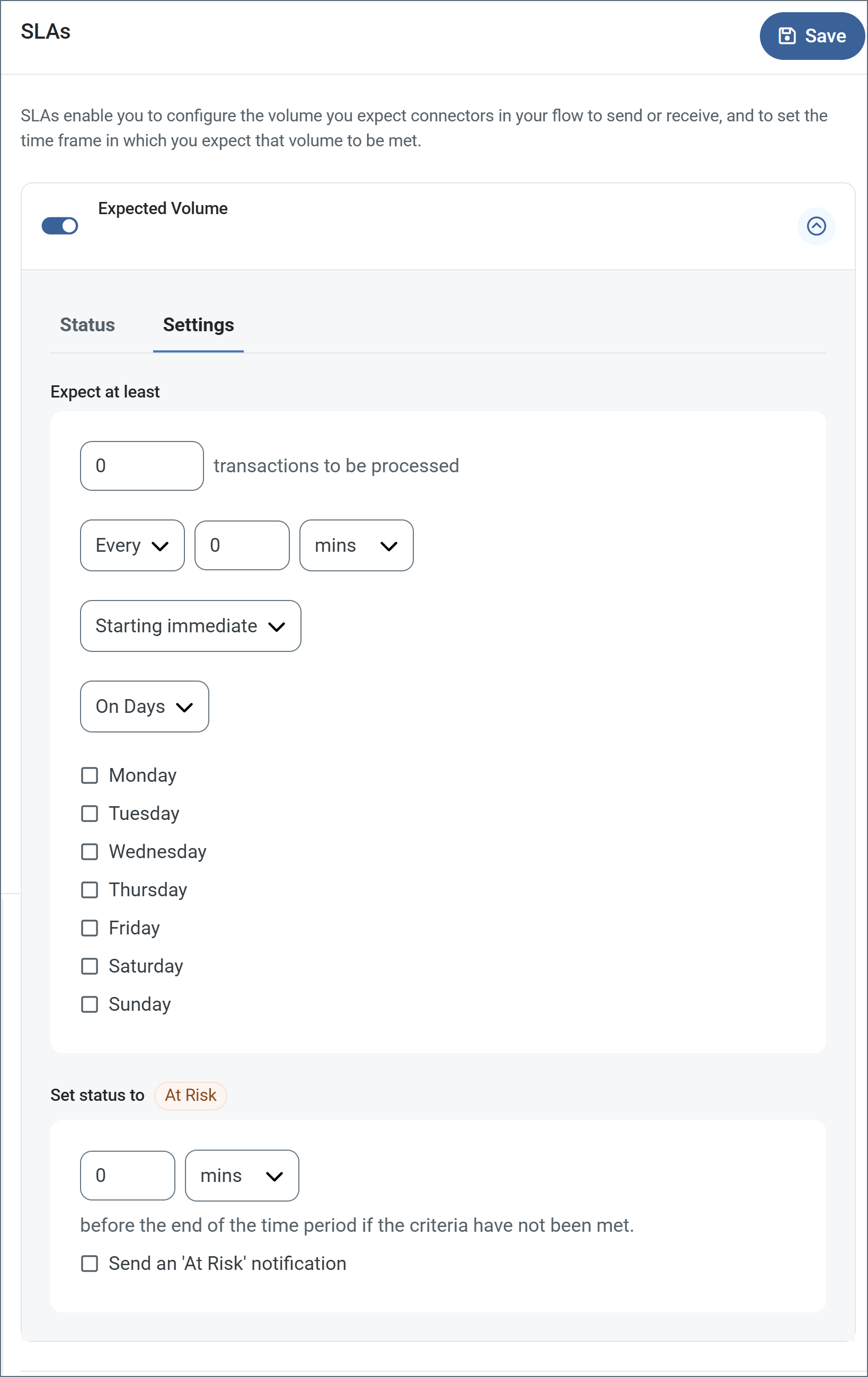
- If your connector has separate send and receive actions, use the radio buttons to specify which direction the SLA pertains to.
- In the Expect at least portion of the window:
- Set the minimum number of transactions you expect to be processed (the volume)
- Use the Every fields to specify the time frame
- Indicate when the SLA should go into effect. If you choose Starting on, complete the date and time fields.
- Check the boxes for the days of the week that you want the SLA to be in effect. Use the dropdown to choose Everyday if necessary.
- In the Set status to 'At Risk' portion of the window, specify when the SLA should be marked as at risk.
- By default, notifications are not sent until an SLA is in violation. To change that, check Send an 'At Risk' notification.
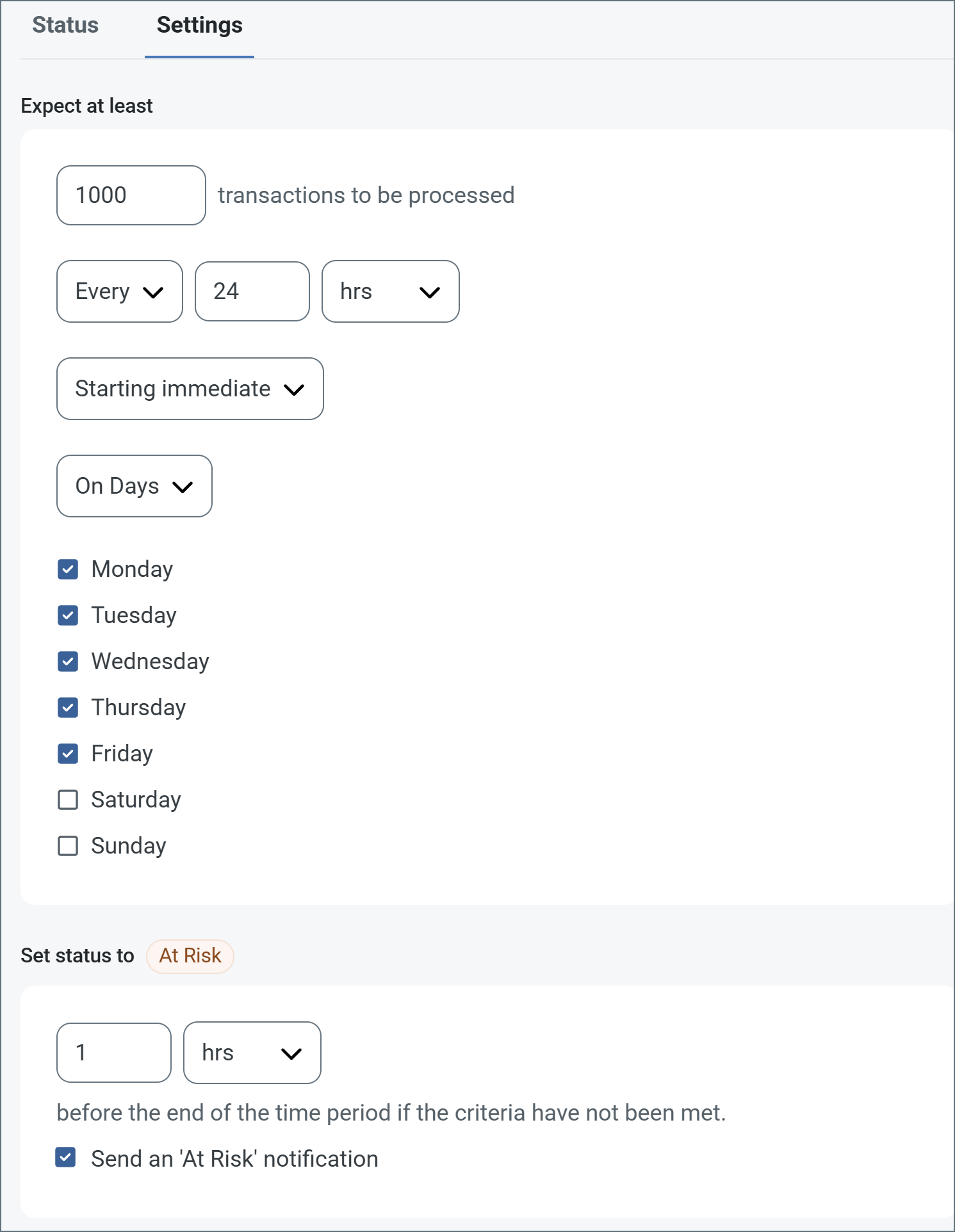
The following example shows an SLA configured for a connector that expects to receive 1000 files every day Monday-Friday. An at-risk notification is sent 1 hour before the end of the time period if the 1000 files have not been received.
 You can turn off SLA alerts if necessary. This can be useful during maintenance windows. Click Settings on the navbar, then navigate to Alerts > General Alerts. Click the tablet and pencil icon to edit, and uncheck the SLA Alerts setting.
;
export const AlertsTab = ({siteNameShort = "Arc"}) => <>
You can turn off SLA alerts if necessary. This can be useful during maintenance windows. Click Settings on the navbar, then navigate to Alerts > General Alerts. Click the tablet and pencil icon to edit, and uncheck the SLA Alerts setting.
;
export const AlertsTab = ({siteNameShort = "Arc"}) => <>
Settings related to configuring alerts.
Before you can execute Service Level Agreements (SLAs), you need to set up email alerts for notifications. By default, {siteNameShort} uses the global settings on the Alerts tab. To use other settings for this connector, toggle Override global setting on.
By default, error alerts are enabled, which means that emails are sent whenever there is an error. To turn them off, uncheck the Enable checkbox.
Enter a Subject (mandatory), then optionally enter a comma-separated list of Recipient emails.
;
export const Message = () => <>
Message settings determine how the connector searches for messages and manages them after processing.
| Setting | Description |
|---|
| Save to Sent Folder |
Check this to copy files processed by the connector to the Sent folder for the connector. |
| Sent Folder Scheme |
Instructs the connector to group files in the Sent folder according to the selected interval. For example, the Weekly option instructs the connector to create a new subfolder each week and store all sent files for the week in that folder. The blank setting instructs the connector to save all files directly in the Sent folder. For connectors that process many transactions, using subfolders can help keep files organized and improve performance. |
;
export const MiscConnector = () => <>
Miscellaneous settings are for specific use cases.
| Setting |
Description |
| Other Settings |
Enables you to configure hidden connector settings in a semicolon-separated list (for example, setting1=value1;setting2=value2). Normal connector use cases and functionality should not require the use of these settings. |
;
export const Logging = () => <>
Settings that govern the creation and storage of logs.
| Setting |
Description |
| Log Level |
The verbosity of logs generated by the connector. When you request support, set this to Debug. |
| Log Subfolder Scheme |
Instructs the connector to group files in the Logs folder according to the selected interval. The Weekly option (which is the default) instructs the connector to create a new subfolder each week and store all logs for the week in that folder. Leaving this setting blank tells the connector to save all logs directly in the Logs folder. For connectors that process many transactions, using subfolders helps keep logs organized and improves performance. |
| Log Messages |
Check this to have the log entry for a processed file include a copy of the file itself. If you disable this, you might not be able to download a copy of the file from the Transactions tab. |
;
export const MacrosExamples = ({extraMacros = []}) => <>
Some macros, such as %Ext% and %ShortDate%, do not require an argument, but others do. All
macros that take an argument use the following syntax: %Macro:argument%
Here are some examples of the macros that take an argument:
- %Header:headername%: Where
headername is the name of a header on a message.
- %Header:mycustomheader% resolves to the value of the
mycustomheader header set on the input message.
- %Header:ponum% resolves to the value of the
ponum header set on the input message.
- %RegexFilename:pattern%: Where
pattern is a regex pattern. For example, %RegexFilename:^([\w][A-Za-z]+)% matches and resolves to the first word in the filename and is case insensitive (test_file.xml resolves to test).
- %Vault:vaultitem%: Where
vaultitem is the name of an item in the vault. For example, %Vault:companyname% resolves to the value of the companyname item stored in the vault.
- %DateFormat:format%: Where
format is an accepted date format (see Sample Date Formats for details). For example, %DateFormat:yyyy-MM-dd-HH-mm-ss-fff% resolves to the date and timestamp on the file.
{extraMacros.filter(item => item.example).map(item => - {item.example}
)}
You can also create more sophisticated macros, as shown in the following examples:
- Combining multiple macros in one filename:
%DateFormat:yyyy-MM-dd-HH-mm-ss-fff%%EXT%
- Including text outside of the macro:
MyFile_%DateFormat:yyyy-MM-dd-HH-mm-ss-fff%
- Including text within the macro:
%DateFormat:'DateProcessed-'yyyy-MM-dd_'TimeProcessed-'HH-mm-ss%
;
export const MacrosTable = ({siteName = "CData Arc", extraMacros = []}) => <>
Using macros in file naming strategies can enhance organizational efficiency and contextual
understanding of data. By incorporating macros into filenames, you can dynamically include
relevant information such as identifiers, timestamps, and header information, providing
valuable context to each file.
{siteName} supports these macros, which all use the following syntax: %Macro%.
| Macro | Description |
|---|
| ConnectorID | Evaluates to the ConnectorID of the connector. |
| Ext | Evaluates to the file extension of the file currently being processed by the connector. |
| Filename | Evaluates to the filename (extension included) of the file currently being processed by the connector. |
| FilenameNoExt | Evaluates to the filename (without the extension) of the file currently being processed by the connector. |
| MessageId | Evaluates to the MessageId of the message being output by the connector. |
| RegexFilename:pattern | Applies a RegEx pattern to the filename of the file currently being processed by the connector. |
| Header:headername | Evaluates to the value of a targeted header (headername) on the current message being processed by the connector. |
| LongDate | Evaluates to the current datetime of the system in long-handed format (for example, Wednesday, January 24, 2024). |
| ShortDate | Evaluates to the current datetime of the system in a yyyy-MM-dd format (for example, 2024-01-24). |
| DateFormat:format | Evaluates to the current datetime of the system in the specified format (format). See Sample Date Formats for the available datetime formats. |
| Vault:vaultitem | Evaluates to the value of the specified vault item. |
{extraMacros.map(item =>
| {item.name} |
{item.description} |
)}
;
export const Performance = () => <>
Settings related to the allocation of resources to the connector.
| Setting |
Description |
| Max Workers |
The maximum number of worker threads consumed from the threadpool to process files on this connector. If set, this overrides the default setting on the Performance Settings portion of the Advanced Settings page. |
| Max Files |
The maximum number of files sent by each thread assigned to the connector. If set, this overrides the default setting on the Performance Settings portion of the Advanced Settings page. |
;
export const siteNameShort = "Arc";
export const siteName = "CData Arc";
The Box connector supports uploading to and downloading from the Box cloud storage service.
## Key Capabilities
* OAuth-based cloud storage integration with automatic token refresh
* Upload and download from the connected Box storage account with recursive subdirectory support
* File filtering, overwrite protection, and recursive subfolder support
* Comprehensive proxy support for enterprise network environments
* Optional caching to ensure only new or updated files are downloaded
## Overview
Each Box connector connects to a specified Box storage account. Within the remote storage, you set a single folder as the upload and download targets.
Files that reach the Box connector in the {siteName} flow are uploaded to the upload target folder, and files found in the download target folder are downloaded and entered into the {siteNameShort} flow. The connector supports upload and download filters to send and receive only specific file names and/or file extensions.
Account authentication uses OAuth, so you must enter account credentials in an external site portal the first time the connector connects. The external portal generates an OAuth token that the connector uses to connect, then the connector handles token refresh automatically.
## Connector Configuration
This section contains all of the configurable connector properties.
### Settings Tab
#### Authorization
Use the **Connect** button to authenticate the connector with the storage service the first time. You are redirected to a site login portal. After you provide the account credentials, an authentication token is returned to {siteNameShort} and stored for repeat use.
#### Send
*Settings related to uploading to the remote storage.*
| Setting | Description |
| ----------------- | ------------------------------------------------------------- |
| **Remote Folder** | Files processed by the connector are uploaded to this folder. |
| **Overwrite** | Whether to overwrite or skip existing files. |
#### Receive
*Settings related to downloading from the remote storage.*
| Setting | Description |
| ----------------- | ----------------------------------------------------------------------------------------------------------------- |
| **Remote Folder** | The remote folder from which files are downloaded. Use a comma-delimited list to specify multiple paths. |
| **File Mask** | A glob pattern that determines which files within the **Remote Path** should be downloaded (for example, \*.txt). |
| **Delete** | Check this to delete successfully downloaded files from the remote storage. |
#### Caching
*Settings related to caching and comparing files between multiple downloads.*
| Setting | Description |
| ------------------------ | ------------------------------------------------------------------------------------------------------------------------------------------------------------------------------------ |
| **File Size Comparison** | Check this to keep a record of downloaded file names and sizes. Previously downloaded files are skipped unless the file size is different than the last download. |
| **Timestamp Comparison** | Check this to keep a record of downloaded file names and last-modified timestamps. Previously downloaded files are skipped unless the timestamp is different than the last download. |
When you enable caching, the file names are case-insensitive. For example, the connector cannot distinguish between `TEST.TXT` and `test.txt`.
### Advanced Tab
#### Advanced Settings
*Settings not included in the previous categories.*
| Setting | Description |
| --------------------------------- | ---------------------------------------------------------------------------------------------------------------------------------------------------------------------------------------------------------------------------------------------------------------------------------------------------------------------------------------------------------------------------------------------------------------- |
| **Recurse remote subdirectories** | Whether to download files in subfolders of the target remote path. |
| **Timeout** | The duration the connector waits for a connection response before throwing a timeout error. |
| **Receive Filter** | A glob pattern filter to determine which files should be downloaded from the remote storage (for example, \*.txt). You can use negative patterns to indicate files that should *not* be downloaded (for example, -\*.tmp). Use this setting when you need multiple **File Mask** patterns. Multiple patterns can be separated by commas, with later filters taking priority except when an exact match is found. |
| **Local File Scheme** | A scheme for assigning filenames to messages that are output by the connector. You can use macros in your filenames dynamically to include information such as identifiers and timestamps. For more information, see [Macros](#macros). |
| **Processing Delay** | The amount of time (in seconds) by which the processing of files placed in the **Transactions** tab is delayed. This is a legacy setting. Best practice is to [use a File connector](../flows/designing-a-flow#interacting-with-the-local-file-system) to manage local file systems instead of this setting. |
#### Proxy Settings
#### Message
#### Logging
#### Miscellaneous
### Automation Tab
#### Automation Settings
*Settings related to the automatic processing of files by the connector.*
| Setting | Description |
| ------------------------- | ----------------------------------------------------------------------------------------------------------------------------------------------------------------------------------------------------------------- |
| **Send** | Whether files arriving at the connector are automatically uploaded. |
| **Retry Interval** | The amount of time before a failed upload is retried. |
| **Max Attempts** | The maximum number of times the connector processes the input file. Success is measured based on a successful server acknowledgement. If you set this to 0, the connector retries the file indefinitely. |
| **Receive** | Whether the connector should automatically poll the remote download path for files to download. |
| **Interval** | The interval between automatic download attempts. |
| **Minutes Past the Hour** | The minutes offset for an hourly schedule. Only applicable when the interval setting above is set to *Hourly*. For example, if this value is set to 5, the automation service downloads at 1:05, 2:05, 3:05, etc. |
| **Time** | The time of day that the attempt should occur. Only applicable when the interval setting above is set to *Daily*, *Weekly*, or *Monthly*. |
| **Day** | The day on which the attempt should occur. Only applicable when the interval setting above is set to *Weekly* or *Monthly*. |
| **Minutes** | The number of minutes to wait before attempting the download. Only applicable when the interval setting above is set to *Minute*. |
| **Cron Expression** | A five-position string representing a cron expression that determines when the attempt should occur. Only applicable when the interval setting above is set to *Advanced*. |
#### Performance
### Alerts Tab
### SLAs Tab
## Establishing a Connection
To establish a connection with the Box connector, use the **Connect** button on the [Settings tab](#settings-tab) to be directed to a login portal site. Enter your account credentials in this portal; it returns an authentication token to the connector. This process is only required the first time the connector connects to the storage service.
## Uploading and Downloading
### Upload
To upload files, set the **Remote Folder** in the [Send](#send) portion of the **Settings** page to the folder where files should be uploaded. Each Box connector uploads to a single folder location.
Use the **Overwrite remote files** option to indicate whether files that already exist in the container should be overwritten or skipped.
After configuration is complete, files placed in the connector **Transactions** tab are uploaded to the remote storage. If **Send Automation** is enabled, the upload happens automatically; otherwise, you can send individual files from the Transactions tab.
### Download
To download files, set the **Remote Folder** in the [Receive](#receive) portion of the **Settings** page to the folder from where files should be downloaded. Use a comma-delimited list to specify multiple folders.
Use the **File Mask** to set a glob filter (for example \*.txt) that limits the downloads to files matching the filter. To specify multiple filters, use the **Receive Filter** option on the Advanced tab.
Use **Delete** to specify whether successfully downloaded files should be removed from the remote storage.
After configuration is complete, files are downloaded according to the **Receive** [Automation](#automation-settings) settings, or you can manually click the **Receive** button on the **Transactions** tab.
## Macros
### Examples